How to Choose the Best Lasik Procedure?
Not all LASIK procedures are the same — and choosing the wrong one for your eye profile can affect both your results and recovery. With over six different laser vision correction technologies available at EyeMantra, the right choice depends on your cornea thickness, prescription strength, lifestyle, and budget.
Advanced LASIK Laser Technology
Over the past two decades, LASIK technology has evolved through three generations of laser platforms. Each generation improved precision, reduced aberrations, and expanded the range of patients who can be safely treated.
How the Excimer Laser Works
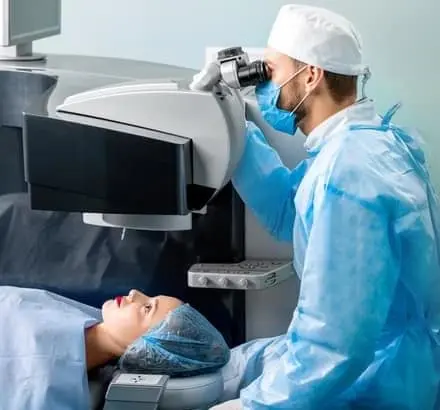
The Excimer laser is the core of LASIK surgery. It delivers ultraviolet light in precise pulses to remove microscopic amounts of corneal tissue — reshaping the cornea’s curvature to correct your vision. The result is permanent and does not involve heat or cutting in the traditional sense.
Laser Delivery Patterns
All FDA-approved LASIK lasers use one of two delivery patterns:
- Flying Spot Scanning Lasers — deliver tiny, rapid pulses of laser energy across the treatment zone. Superior for customised treatments because of greater precision over irregular surfaces.
- Slit Scanning Lasers — deliver energy in a broader slit pattern. Faster treatment time but less granular customisation.
Wavefront Technology
Wavefront mapping creates a unique 3D ‘fingerprint’ of your eye’s optical imperfections — aberrations that standard glasses cannot correct. Three levels of wavefront-based treatment exist:
- Wavefront Optimised: Corrects standard refractive errors while preserving natural corneal shape.
- Wavefront Guided (Custom LASIK): Uses your personal wavefront map to correct higher-order aberrations — improves contrast sensitivity and night vision.
- Topography Guided (Contoura Vision): Maps 22,000 data points on your corneal surface for the highest level of personalisation available today.
Comparing LASIK Surgery Types: Which Is Best for You?
| Surgery Type | Best For | Flap Used? | Recovery |
| Standard LASIK | Mild myopia/hyperopia, large corneas, tight budgets | Yes (blade) | 1–3 days |
| Femto LASIK | Thin corneas, blade-free preference | Yes (laser) | 1–3 days |
| Contoura Vision | Irregular astigmatism, high-quality vision demand | Yes (laser) | 1–3 days |
| SMILE | Dry eye patients, athletes, thin corneas | No (flapless) | 2–5 days |
| PRK / TransPRK | Very thin corneas, not eligible for LASIK | No flap | 5–7 days |
| ICL (Implant) | High myopia >-8D, thin corneas, very dry eyes | No laser | 1–2 days |
Every LASIK procedure comes with different technology and treatment benefits, which can affect the overall surgery cost. You can check detailed pricing and cost factors on our LASIK Surgery Cost page.
Contoura Vision LASIK — Topography-Guided Laser Surgery
Contoura Vision is currently the most advanced flap-based LASIK technology available in India, and is FDA-approved for superior visual outcomes compared to standard LASIK in clinical trials.
How Contoura Vision Differs from Standard LASIK
While standard and Femto LASIK correct only your spectacle prescription (sphere and cylinder), Contoura Vision goes further — it maps 22,000 unique data points on your corneal surface using a high-resolution topographer, then programs the excimer laser to correct both your prescription and your cornea’s individual micro-irregularities.
This means patients with Contoura Vision often achieve vision quality that exceeds what they experienced even with glasses or contact lenses.
Book Free Consultation
Book Appointment or Video Consultation online with top eye doctors
Free LASIK Consultation at EyeMantra
A thorough pre-operative consultation is the foundation of safe LASIK surgery. Here is what we assess during your free evaluation:
- Refraction Test — Measures your exact spectacle prescription
- Corneal Topography — Maps the curvature and surface of both corneas
- Corneal Thickness (Pachymetry) — Confirms adequate tissue for safe ablation
- Pupil Size Measurement — Evaluated in dim light to assess night vision risk
- Dry Eye Assessment — Schirmer’s test and slit-lamp examination
- Retinal Evaluation — Rules out any retinal thinning or detachment risk
- Personalised Surgery Recommendation — Based on all findings above
Am I a Good Candidate for LASIK? — Quick Checklist
You are likely eligible for LASIK if you meet all of the following criteria:
- Age 18 or above, with a stable prescription for at least 12 months
- Corneal thickness of 480 microns or more (measured during consultation)
- Prescription within treatable range: Myopia up to -10D, Hyperopia up to +6D, Astigmatism up to 6D
- No active eye diseases (keratoconus, glaucoma, severe dry eye, retinal disorders)
- Not pregnant or breastfeeding
- No autoimmune conditions that affect healing (lupus, rheumatoid arthritis, etc.)
If you do not meet the standard LASIK criteria, alternatives like SMILE, PRK, or ICL implants may still allow you to achieve spectacle independence.
Frequently Asked Question's
How do I know which LASIK procedure is right for me?
The right LASIK procedure is determined by a pre-operative eye examination, not personal choice. Your surgeon will assess your cornea thickness, prescription strength, pupil size, dry eye status, and corneal topography before recommending a procedure. Most patients with standard prescriptions and healthy corneas are suitable for Femto LASIK or Contoura Vision. Patients with very thin corneas, dry eyes, or an active lifestyle are often better candidates for SMILE or PRK.
Is LASIK a permanent solution?
Yes- LASIK permanently reshapes the cornea, and the correction is irreversible. However, the natural ageing process of the eye can cause your vision to change after surgery, particularly after age 40 (presbyopia) or in cases of early cataracts. Most patients enjoy stable vision for 10–20 years or more.
Is there any LASIK technology that guarantees 6/6 vision?
Does the choice of LASIK type affect the recovery time?
Will I feel pain during LASIK surgery?
No- anaesthetic eye drops are applied before surgery, making the procedure essentially painless. You may feel a slight pressure sensation during the flap creation step (in LASIK) and possibly mild discomfort or a foreign-body sensation in the hours immediately after surgery. Most patients are comfortable enough to rest or sleep within a few hours.