Common Vision Problems LASIK Can Fix
LASIK is a popular laser eye surgery used to correct common vision problems like myopia (nearsightedness), hyperopia (farsightedness), and astigmatism. These conditions occur when light does not focus properly on the retina, causing blurred vision.
Book Free Consultation
Book Appointment or Video Consultation online with top eye doctors
How Vision Problems Affect Your Eyes
Vision problems occur when the eye cannot properly focus light onto the retina. This leads to blurred or distorted vision.
In a healthy eye, light passes through the cornea and lens and focuses directly on the retina. However, in conditions like myopia, hyperopia, and astigmatism, this focus is disrupted.
LASIK surgery works by reshaping the cornea so that light can focus correctly on the retina, improving vision clarity.
Understanding Your Eye Power (Prescription Explained)
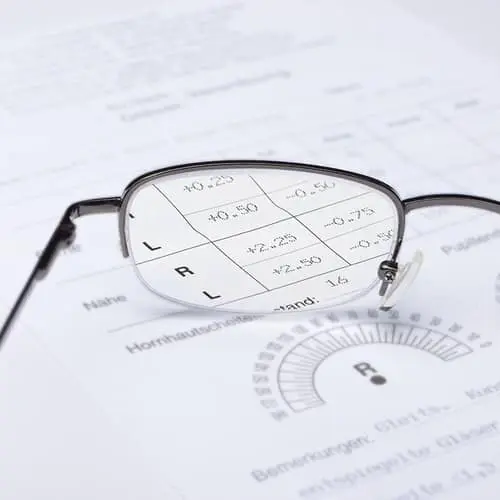
Myopia, hyperopia, astigmatism, and presbyopia are some of the most frequent vision issues. These difficulties are very typical and are measured using a diopter that measures the light bending qualities of an optical system. To cure your eyesight concerns, you can use glasses or lenses. The symbol for glasses to indicate the diopter is “D”, while the symbol for contact lenses is “C”. A (-) figure is used to designate glasses that correct for nearsightedness, and a (+) sign is used to indicate glasses that help with long-sightedness.
A typical prescription includes three basic category one numbers, indicating the degree of nearsightedness or long-sightedness, the other number identifies the degree of astigmatism, and the third number refers to the axis and direction of astigmatism. The greater your vision problems are, the more dioptres you will require in your prescription. People with vision problems often require different corrective measures for each eye. The right and left eye will have separate values written next to them.

Vision Problems LASIK Can Fix
You may understand the vision problem you’re experiencing and check your dioptre values after any of the following difficulties, then visit a doctor for a consultation.

Myopia (Nearsightedness)
Myopia (nearsightedness) is one of the most common vision problems LASIK can treat. People with myopia can see nearby objects clearly but struggle with distant vision.
LASIK corrects myopia by flattening the cornea so that light focuses properly on the retina. Most patients with mild to moderate myopia achieve excellent results after LASIK.
Hyperopia (Farsightedness)
Hyperopia, or farsightedness, is a problem where things at a distance are easy to see but nearby items are difficult. Hyperopia’s symptoms can be severe headaches and blurred vision if it isn’t treated quickly. To improve the focusing power, the aim of laser eye surgery is to elongate the eye and make the cornea more curved. The power of the lens that’s used to fix vision is given in diopters, with a plus sign.
Astigmatism
The eyes are not completely round when someone has astigmatism. The corneal curvature is not entirely symmetrical, and the cornea is irregular. Light scattering due to irregularities causes visual abnormalities. The asymmetry in the eye’s curvature is corrected by reshaping the uneven portions of the cornea with lasers. Cylindrical lenses may also be used. Lasik surgery can provide a long-term cure by correcting the vision and preventing the need for glasses or contact lenses.
Vision Problems LASIK Cannot Fix
While LASIK is highly effective for correcting common refractive errors, it is not suitable for all eye conditions. LASIK works by reshaping the cornea, so it cannot treat problems that originate in other parts of the eye.
Here are some vision problems LASIK cannot fix:
Cataracts
Cataracts occur when the natural lens of the eye becomes cloudy, leading to blurred or dim vision. Since LASIK does not replace the lens, it cannot treat cataracts. The only effective treatment is cataract surgery, where the cloudy lens is replaced with an artificial intraocular lens (IOL).
Glaucoma
Glaucoma is a condition caused by increased pressure inside the eye, which can damage the optic nerve and lead to vision loss. LASIK does not reduce eye pressure or prevent optic nerve damage, so it is not a treatment for glaucoma.
Presbyopia (Age-Related Vision Loss)
Presbyopia affects the eye’s ability to focus on near objects, typically after the age of 40. While LASIK can correct distance vision, it does not fully stop age-related changes in the eye. Some patients may still need reading glasses after LASIK.
Severe Dry Eye Syndrome
LASIK can temporarily worsen dry eye symptoms. If you already have severe dry eyes, you may not be a suitable candidate until the condition is treated and stabilized.
Retinal Diseases
Conditions like retinal detachment, macular degeneration, or diabetic retinopathy affect the back of the eye (retina). Since LASIK only reshapes the cornea, it cannot treat these serious conditions.
Extremely High Eye Power
Patients with very high myopia or hyperopia may not be ideal candidates for LASIK due to corneal limitations. In such cases, alternatives like ICL (Implantable Contact Lens) or other procedures may be recommended.
If LASIK is not suitable for your condition, don’t worry—there are several advanced vision correction options available. A detailed eye examination can help determine the safest and most effective treatment for your specific needs.
Benefits of LASIK for Vision Problems
LASIK is a safe and effective way to correct common vision problems like myopia, hyperopia, and astigmatism. It improves vision clarity while reducing dependence on glasses or contact lenses.
- Clear Vision Without Glasses- Most patients achieve sharp vision without needing glasses or contact lenses for daily activities.
- Quick & Painless Procedure- The surgery takes about 10–15 minutes per eye and is virtually painless with numbing drops.
- Fast Recovery- Vision improves within 24–48 hours, and most people return to normal routines quickly.
- Long-Lasting Results- LASIK provides permanent correction for refractive errors, with stable results over time.
- Better Lifestyle- Enjoy more freedom in sports, travel, and daily life without the hassle of eyewear.
For many people, LASIK is not just about better vision—it’s about a better lifestyle.
Frequently Asked Question's
Can LASIK fix astigmatism and nearsightedness at the same time?
Yes. Modern LASIK technology can reshape the cornea to correct both nearsightedness and astigmatism in a single procedure.
Is there a limit to how high a prescription LASIK can fix?
Generally, LASIK can treat up to -12.00D of nearsightedness, +6.00D of farsightedness, and 6.00D of astigmatism, depending on your corneal thickness.
Can LASIK fix "old age" reading vision (Presbyopia)?
Standard LASIK does not fix presbyopia, but “Monovision LASIK” is a specialized technique that can help patients see both near and far.
Does LASIK provide a permanent fix for vision problems?
LASIK permanently reshapes the cornea. While your eyes can still change naturally due to aging (like cataracts), the correction made by the laser is permanent.
