
Contoura Vision LASIK (Topography-Guided Laser Eye Surgery)
If you’ve worn glasses or contacts your whole life and want the clearest vision possible — not just functional vision — Contoura Vision was built for you.
What Is Contoura Vision?
Contoura Vision is an advanced, topography-guided LASIK technology designed to deliver highly personalized and precise vision correction.
Unlike standard LASIK, which corrects vision based mainly on your spectacle number, Contoura Vision goes a step further by analyzing the actual shape and irregularities of your cornea.
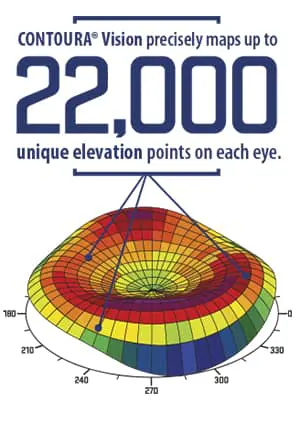
Using a specialized topography system, Contoura maps up to 22,000 unique elevation points on your cornea. This allows the surgeon to treat not just the power, but also the microscopic imperfections that affect the quality of your vision.
This is why many patients experience: Sharper clarity, Better contrast sensitivity, Improved night vision (less glare and halos).
Book Free Consultation
Book Appointment or Video Consultation online with top eye doctors
Contoura Vision vs Standard LASIK
| Feature | Standard LASIK | Contoura Vision |
|---|---|---|
| Treatment Axis | Pupillary axis | Visual axis (natural line of sight) |
| Data Points Mapped | Limited | Up to 22,000 points |
| Corneal Irregularity Correction | No | Yes |
| Night Vision Quality | Standard | Superior (reduced glare & halos) |
| Customisation Level | Basic | Fully topography-guided |
If standard LASIK corrects your vision, Contoura Vision enhances the quality of your vision—making it the preferred choice for patients seeking maximum clarity and precision.

How Contoura Vision Works (Topography-Guided Technology)
Contoura Vision stands out because of its topography-guided precision, which allows surgeons to correct not just your eye power, but also the microscopic irregularities on your cornea that affect visual quality.
Step-by-Step Procedure:
- A specialized topography device captures up to 22,000 unique elevation points across your cornea. This creates an extremely detailed map of even the smallest imperfections.
- Unlike standard LASIK, Contoura identifies subtle irregularities that can cause: Glare, Halos, Poor night vision
- The treatment is fully customized based on your corneal map, ensuring that both: Refractive error (myopia & astigmatism), Surface irregularities are corrected together.
- An advanced excimer laser reshapes the cornea using this data, resulting in a smoother and more optically accurate surface.
Unlike conventional LASIK which treats along the pupillary axis, Contoura Vision operates on the visual axis — the true line along which your eye naturally sees. This distinction is why Contoura patients consistently report sharper, more natural vision compared to standard laser procedures.
Contoura Vision Benefits — What You Get That Standard LASIK Doesn't
In FDA clinical trials, over 98% of Contoura Vision patients achieved 20/20 vision or better — and nearly 65% achieved better than 20/20.
Some of the advantages of Contoura Vision eye surgery are:
- Provide you with better contrast sensitivity and night vision.
- Gives you a wider field of view than traditional LASIK surgery.
- Surgeon can use preoperative measurements to create a more customized treatment plan for your eyes.
- Greater accuracy leading to better vision correction results.
- Many patients achieve better than 20/20, seeing details their corrective lenses never delivered
- Safest and effective way to improve your vision, with low risk of complications.
- Contoura Vision has been approved and used globally with consistently high patient satisfaction

Who Is the Right Candidate for Contoura Vision Surgery?
Contoura Vision is particularly well-suited for patients who:
- Have myopia (nearsightedness) up to -12D or astigmatism up to -8D
- Want the highest possible visual quality, not just functional correction
- Have corneal irregularities or aberrations that affect quality of vision
- Experience halos, glare, or poor night vision with their current prescription
- Have had a stable prescription for at least 1 year
- Are 18 years or older with adequate corneal thickness
A topography scan during your pre-surgery consultation will confirm whether Contoura is the right treatment for your corneal profile. Not every eye is an ideal Contoura candidate — our surgeons will tell you honestly.
Contoura Vision Aftercare
There are a few things you need to do in order to ensure a successful recovery from Contoura Vision surgery.
First and foremost, it is important to follow all of your eye surgeon’s post-operative instructions. This will help to ensure that your eyes heal properly and that you do not experience any complications.
Some of the things you may be instructed to do include:
- Wearing protective eye shields at night for the first week after surgery
- Applying artificial tears as often as needed to keep your eyes moist
- Taking antibiotics as prescribed to prevent infection
- It is also important to avoid rubbing or touching your eyes for at least four weeks after surgery.
In most cases, people who have Contoura Vision surgery experience little to no discomfort and are able to resume their normal activities within a few days. However, it is still important to take things easy for the first week or so and avoid strenuous activity or anything that could jar or bump your eyes.
With proper care and attention, you should be able to enjoy your new, improved vision for many years to come.
Contoura Vision Cost
Contoura Vision Cost at EyeMantra is Rs. 25,000 per eye. It is a new type of laser vision correction that gives you better results than traditional LASIK. The cost of the surgery is higher because it is a new technology and it is not yet available in all hospitals.
We have a team of experienced and skilled surgeons who have performed thousands of LASIK surgeries. We uses the latest technology. You can be assured that you will get the best possible treatment at the EyeMantra Hospital.
| Procedure | Recovery Time | Procedure Type | Suitability (High Power / Thin Cornea) | Key Benefit | Price/Eye (₹) |
|---|---|---|---|---|---|
| LASIK | Slow | Blade Flap | Basic technology | 10,000 | |
| PRK LASIK | Very Slow | Flapless | Safe, flapless procedure for thin corneas | 12,000 | |
| Contoura Vision | Slow | Blade Flap | Sharper and personalized vision correction | 25,000 | |
| EPI Contoura | Very Slow | Flapless | Flapless Contoura for high power or thin corneas | 30,000 | |
| TransPRK | Fast | Flapless | 100% touchless and safer than traditional LASIK | 30,000 | |
| SmartSurf LASIK | Very Fast | Flapless | Touchless, painless, and fast healing | 37,500 | |
| Femto LASIK | Next day | Laser Flap | Laser flap with high accuracy and quick recovery | 47,500 | |
| Custom Eyes with Foresight Pro | Very Fast | Flapless | AI-guided precision with HD clarity | 47,500 | |
| Wavelight Innoveyes | Fast | Blade Flap / Flapless | Premium laser with ray tracing | 70,000 | |
| SMILE / SILK | Fast | Flapless | Advanced lenticule-based correction | 60,000 | |
| CLEAR NEO | Very Fast | Flapless | Most advanced, painless and fastest recovery | 60,000 |

Why Choose EyeMantra for Contoura Vision Surgery?
At EyeMantra, we focus on delivering high-accuracy, personalized Contoura Vision treatments using advanced technology and experienced refractive surgeons.
- Our team has performed thousands of successful vision correction surgeries, including a significant number of Contoura Vision cases
- We specialize in corneal mapping-based treatments, ensuring every procedure is customized to your eye’s unique structure
- Procedures are performed by trained ophthalmic surgeons with experience in advanced LASIK technologies and refractive surgery
- Detailed diagnostic testing ensures that only suitable candidates undergo Contoura Vision, improving safety and outcomes
- Fully equipped modular operation theatres with strict sterilization protocols
If you’re considering Contoura Vision LASIK for sharper and more precise vision, choosing a clinic with the right technology and experience can make all the difference. Book your consultation today to check your eligibility and get a personalized treatment plan.


Top Contoura Vision LASIK Surgeons
We have the most experienced and skilled surgeons in the field, and our state-of-the-art facilities are equipped with the latest technology. This allows us to provide you with the best possible care and results.

Cataract, Retina, Glaucoma, LASIK
Cataract, Cornea
Cataract, Squint, Oculoplastic
Cataract, Retina, Glaucoma
Frequently Asked Question's
Contoura Vision is a topography-guided LASIK procedure that maps up to 22,000 unique points on your corneal surface to create a fully personalized treatment plan. Unlike standard LASIK which only corrects your spectacle power, Contoura also corrects corneal irregularities and treats along the visual axis — the eye’s natural line of sight — resulting in sharper, more precise vision outcomes.
Yes. Contoura Vision received US FDA approval and has been used in clinical practice globally. FDA trial data showed that over 98% of patients achieved 20/20 vision or better, with nearly 65% achieving better than 20/20 — results exceeding standard LASIK benchmarks.
Ideal candidates have myopia up to -12D or astigmatism up to -8D, adequate corneal thickness, a stable prescription for at least 12 months, and are 18 years or older. Patients with corneal surface irregularities or those experiencing poor night vision with glasses are particularly well-suited for Contoura.
Most patients notice clear improvement within 24–48 hours. Full visual stabilisation typically occurs within 1–3 months. Recovery instructions include using prescribed eye drops, avoiding eye rubbing, and staying away from swimming or dusty environments for the first week.
Contoura Vision has a strong safety profile. Potential risks include dry eyes (usually temporary), halos or glare during the healing period, and in rare cases, under or over-correction. The risk of serious complications is very low when performed by an experienced surgeon after thorough pre-surgical screening.
In some cases, Contoura Vision can be performed on eyes that have had previous LASIK — particularly to address residual refractive error or corneal irregularities from prior surgery. This requires a detailed corneal assessment to confirm suitability. Consult your surgeon for an evaluation.
