
PRK Eye Surgery (Photorefractive Keratectomy)
If your corneas are too thin for LASIK, or you’ve been advised against flap-based surgery, PRK (Photorefractive Keratectomy) is not a compromise — it’s a clinically superior choice for your specific anatomy.
Book Free Consultation
Book Appointment or Video Consultation online with top eye doctors
What Is PRK Eye Surgery & Why Is It Different from LASIK?
PRK (Photorefractive Keratectomy) is a surface laser eye surgery that corrects refractive errors by reshaping the cornea, the clear front surface of the eye.
It is often recommended for patients who are not eligible for LASIK due to thin corneas, dry eyes, or corneal irregularities.
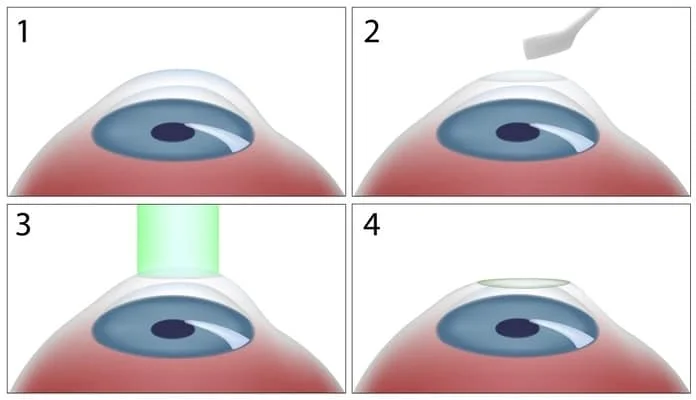
During the procedure, the outer layer of the cornea (epithelium) is gently removed, and an excimer laser reshapes the underlying corneal tissue to improve how light focuses on the retina.
PRK is an outpatient procedure and typically takes about 10–15 minutes per eye. Vision gradually improves over time, with most patients experiencing stable results within a few weeks to months.
How PRK Surgery Works — Step by Step
PRK is performed using a precise laser-based process:
- First, the thin outer layer of the cornea (epithelium) is carefully removed. This may be done using a special solution, brush, or laser technique.
- Next, an excimer laser reshapes the cornea based on your prescription to correct vision errors.
- A clear, soft bandage contact lens is placed over the eye. This protects the cornea and significantly reduces discomfort while the epithelium regenerates — typically over 3–5 days.
- Your eye’s natural epithelium regrows over the treated surface. The bandage lens is removed at your follow-up appointment, usually 4–5 days post-surgery.
The procedure is quick, usually taking less than 15 minutes per eye, and is performed on an outpatient basis. Unlike LASIK, PRK does not involve creating a corneal flap, which eliminates flap-related complications.

Why PRK May Be the Better Choice — Key Advantages Over LASIK
PRK surgery involves permanently changing the shape of your eye’s cornea, which is the clear, dome-shaped surface that covers the front of your eye.

PRK offers several important advantages, especially for patients who are not suitable for LASIK:
- Ideal for patients with thin corneas
- No corneal flap, reducing long-term flap complications
- Safer for people in contact sports or physically active jobs
- No risk of flap complications with PRK
- Effective and stable long-term vision correction
- Lower risk of dry eye compared to flap-based procedures in some cases
- Suitable for certain corneal surface irregularities
PRK is often the preferred option when LASIK is not safe or recommended.
PRK vs LASIK- Which Should You Choose?
| Feature | PRK (Photorefractive Keratectomy) | LASIK |
|---|---|---|
| Corneal flap | No flap is created (surface procedure) | A corneal flap is created |
| Suitable for thin corneas | Yes, ideal for thin corneas | Not suitable for very thin corneas |
| Initial recovery | Slower (3–7 days discomfort possible) | Faster (24–48 hours) |
| Full vision stabilization | 1–3 months | 2–6 weeks |
| Flap-related risks | No flap, so no flap complications | Small risk of flap displacement |
| Dry eye risk | Lower in many patients | Slightly higher in early healing phase |
| Suitability for sports / active lifestyle | Better (no flap risk) | Less preferred for contact sports |
| Final vision outcome | Excellent long-term stability | Excellent with faster recovery |
If your corneas qualify for LASIK and you prefer faster recovery, LASIK may suit you. If your corneas are thin, you have a physically demanding lifestyle, or you’ve been told you’re not a LASIK candidate — PRK delivers the same quality of vision with a stronger long-term safety profile. Our surgeons will advise you based on your corneal measurements, not preference.
PRK Risks
There are certain side effects that people may experience after LASIK surgery. These are usually temporary. They include:


PRK Recovery & Aftercare — What to Expect Week by Week
After your PRK surgery, you will need to take care of your eyes to ensure a successful recovery.
Here are some aftercare tips:
- Days 1–3: Light sensitivity, mild discomfort, and blurred vision are normal. The bandage contact lens remains in place. Rest at home. Use prescribed antibiotic, steroid, and lubricating drops as directed. Avoid screens where possible.
- Days 3–5: The bandage contact lens is removed at your follow-up appointment once the epithelium has regenerated. Vision begins to improve noticeably.
- Week 1–2: Vision may fluctuate — this is normal during PRK. Avoid rubbing your eyes, swimming, saunas, or dusty environments. Continue eye drop regimen.
- Week 2–4: Most patients are back to work and daily activities. Driving is typically possible once your surgeon confirms adequate visual acuity.
- Months 1–3: Vision continues to sharpen and stabilise. Mild halos or light sensitivity may persist and typically resolve during this period.
Important: PRK recovery takes longer than LASIK — this is expected and normal. The final visual outcome is comparable. Do not judge your results in the first 2–4 weeks.

PRK Eye Surgery Cost
The cost of PRK surgery with EyeMantra is very affordable. We offer a variety of payment options to make the surgery as affordable as possible for our patients. There are a number of financing options available for those who qualify. We also accept major credit cards and offer a variety of discounts for those who pay cash up front.
| Procedure | Recovery Time | Procedure Type | Suitability (High Power / Thin Cornea) | Key Benefit | Price/Eye (₹) |
|---|---|---|---|---|---|
| LASIK | Slow | Blade Flap | Basic technology | 10,000 | |
| PRK LASIK | Very Slow | Flapless | Safe, flapless procedure for thin corneas | 12,000 | |
| Contoura Vision | Slow | Blade Flap | Sharper and personalized vision correction | 25,000 | |
| EPI Contoura | Very Slow | Flapless | Flapless Contoura for high power or thin corneas | 30,000 | |
| TransPRK | Fast | Flapless | 100% touchless and safer than traditional LASIK | 30,000 | |
| SmartSurf LASIK | Very Fast | Flapless | Touchless, painless, and fast healing | 37,500 | |
| Femto LASIK | Next day | Laser Flap | Laser flap with high accuracy and quick recovery | 47,500 | |
| Custom Eyes with Foresight Pro | Very Fast | Flapless | AI-guided precision with HD clarity | 47,500 | |
| Wavelight Innoveyes | Fast | Blade Flap / Flapless | Premium laser with ray tracing | 70,000 | |
| SMILE / SILK | Fast | Flapless | Advanced lenticule-based correction | 60,000 | |
| CLEAR NEO | Very Fast | Flapless | Most advanced, painless and fastest recovery | 60,000 |

Is PRK cheaper than LASIK? PRK is generally comparable in cost to standard LASIK and less expensive than premium procedures like Contoura Vision or SMILE. The decision should always be based on your eye’s suitability — not the price point.
We offer flexible payment options including EMI. Contact us after your free corneal evaluation for a personalised cost estimate.
Why Choose EyeMantra for PRK Surgery?
We focus on advanced laser vision correction using modern excimer laser technology and personalized treatment planning.
Our goal is to ensure safe, precise, and long-term vision correction for patients who are not suitable for LASIK.
From detailed pre-surgery evaluation to post-surgery recovery support, every step is designed to maximize safety, comfort, and visual outcomes.
EyeMantra is committed to maintaining high clinical standards with NABH-aligned protocols and strict surgical safety guidelines, ensuring patient safety at every step—from diagnosis to post-operative recovery.
If you are considering PRK or comparing PRK vs LASIK, our specialists can guide you toward the most suitable option after a complete eye assessment.


Top PRK Surgeons
We have the most experienced and skilled surgeons in the field, and our state-of-the-art facilities are equipped with the latest technology. This allows us to provide you with the best possible care and results.

Cataract, Retina, Glaucoma, LASIK
Cataract, Cornea
Cataract, Squint, Oculoplastic
Cataract, Retina, Glaucoma
Our Facilities
Frequently Asked Question's
PRK vs LASIK – which is better?
PRK is better for patients with thin corneas or those not eligible for LASIK. LASIK offers faster recovery, while PRK avoids flap-related complications and is safer for certain eye conditions.
Is PRK safe for thin corneas?
Yes, PRK is often preferred for patients with thin corneas because it does not involve creating a corneal flap, making it a safer alternative to LASIK.
How long does PRK recovery take?
Initial healing takes a few days, but full visual stabilization can take 1 to 3 months depending on the individual.
How do I know if I'm a candidate for PRK?
A pre-surgical corneal evaluation including corneal topography and pachymetry (corneal thickness measurement) determines your suitability. If your corneal thickness is insufficient for LASIK — typically below 500 microns — PRK is often the safest laser vision correction option available to you.
What are the risks of PRK surgery?
PRK is a well-established, safe procedure. Potential risks include temporary dry eye, halos or glare during the healing period, delayed visual stabilisation, and — in rare cases — under or over-correction requiring enhancement. Because no flap is created, PRK eliminates flap-related complications entirely. Serious complications are rare when performed by an experienced surgeon after thorough pre-surgical screening.
